Thunderstorms in the mountains
what to do if one catches you on the trail?
Wróć do listyMountains fascinate with their majesty and beauty, but they can also be unpredictable and dangerous. One of the biggest threats you can encounter while hiking in the mountains is a thunderstorm. Read this article to find out what to do if a storm catches you on the trail and how to prepare for changing weather conditions to minimise the risk of being caught in a thunderstorm in the mountains.
How does a thunderstorm form?
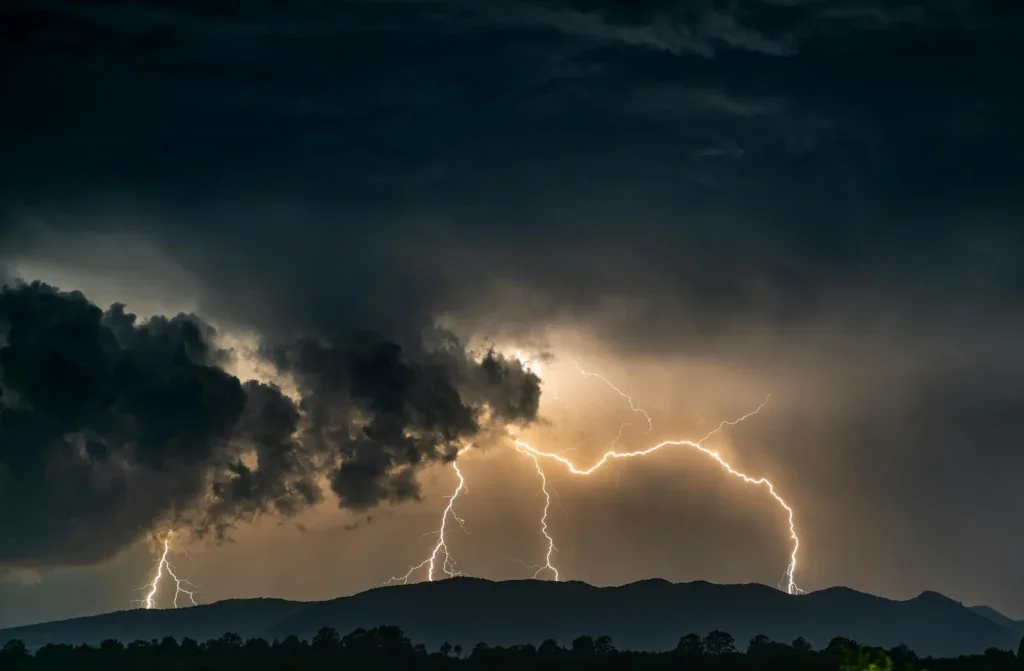
First, a bit of meteorological theory. A thunderstorm is a fascinating but dangerous weather phenomenon that can take you by surprise while hiking in the mountains. It develops in storm clouds known as cumulonimbus. These huge clouds form when warm, moist air rises rapidly and meets cooler layers of the atmosphere. This is the moment when you can see rapidly growing, billowing towers with a clear vertical extent in the sky – a sign that the atmosphere is unstable and a storm may develop. In the mountains this process is particularly intense because of the terrain – steep slopes force air masses to move upwards.
How a storm cloud develops
When water vapour condenses and cloud droplets form, huge amounts of energy are released. This lets the air keep rising and the cumulus cloud keep building vertically, often to a height of several kilometres – and on summer days even more than ten. When the top of the cloud takes on the characteristic shape of a fibrous anvil or mushroom, it means the cumulus has turned into a thundery cumulonimbus.
Electrical discharges
Inside a storm cloud, electrical charges become separated. The upper part of the cloud collects positive charges, while the lower part collects negative ones. When the potential difference between these areas becomes too great, a sudden electrical discharge occurs, which we see as lightning. The thunder that accompanies it is simply a sound wave created when the lightning bolt heats the air in an instant.
In the mountains, this whole process can unfold extremely quickly. A storm can develop "out of nowhere", surprising even experienced hikers. That's why it's so important to always stay alert while hiking in the mountains and watch for changes in the sky.
Why can a thunderstorm in the mountains be dangerous for hikers?
A thunderstorm in the mountains is not only a spectacular show but, above all, a real threat to hikers' lives and health. Why?
- Mountain weather changes quickly. A storm can arrive unexpectedly, even if the sky was cloudless in the morning.
- Ridges and summits are natural "magnets" for lightning. If you find yourself in open terrain during a mountain storm, you may become the highest point around, which increases the risk of being struck.
- If the weather suddenly turns bad, finding safe shelter can be difficult, especially on demanding trails.
- Storms are often accompanied by heavy rain and fog, which make it hard to find your way and move safely along the trail.
- Rain also makes rocks and paths very slippery, increasing the risk of falls and injuries.
- Getting soaked and a sudden drop in temperature can lead to hypothermia, which is particularly dangerous in mountain conditions.
Thunderstorms in the mountains – how to avoid getting caught in one?
If we were to answer this question in black-and-white terms, the best answer would probably be: don't go into the mountains. But of course, you're not here to be put off mountain hiking. Even so, when you decide to head into the mountains, you need to be aware that you have no control over the weather. You can, however, prepare properly for its whims. How? What can you do so that a storm doesn't catch you on your way to the summit? We have a few tips!
1. Check the weather
Always check the weather forecast before setting off into the mountains. A clear sky in the morning doesn't mean you won't run into a cloudburst a few hours and a few kilometres higher up. The best way to plan a hike that takes weather changes into account is to use reliable sources and forecasts, such as:
- official meteorological services, e.g. the website of the Polish Institute of Meteorology and Water Management (IMGW), where you'll find detailed weather forecasts, including for mountain areas (here you'll find information on the forecast for the Śnieżnik area),
- GOPR or TOPR (mountain rescue) announcements for up-to-date warnings,
- local forecasts for mountain areas,
- wind-monitoring services, e.g. windy.com, where you can check the temperature at the nearest weather stations, cloud cover and lightning,
- mobile apps, e.g. Blitzortung (where you can set a storm alarm for a chosen distance) or Monitor Burz for Android and iOS devices, which shows lightning strikes and their movement directly on maps.
Don't check just once – monitor the forecast several times using different sources: while planning the trip, the day before and on the morning of the hike, as well as during the hike itself.
2. Set off early
An early start is the foundation of a safe mountain hike. Mountain thunderstorms most often form in the afternoon. If you set off at the crack of dawn, you'll reduce the risk of encountering lightning on the trail, avoid the crowds on popular routes and, above all (and this is especially important), you'll gain more time to safely reach your destination, turn back if needed or descend to the nearest shelter if conditions get difficult.
3. Plan your route wisely
When choosing the destination of your hike, take into account:
- the length and difficulty of the route,
- your skills and fitness,
- the location of mountain huts and places where you could wait out a storm,
- the forecast times of lightning activity.
Try to plan your route so that you tackle the most exposed sections (e.g. ridges, summits) in the first part of the day. Apps such as Mapa Turystyczna (which works as an overlay on Google Maps) or Mapy.cz, which lets you download offline maps, can be useful for planning mountain hikes.
4. Watch the sky
Keep an eye on the sky regularly during your hike. Look up and pay attention to warning signs such as:
- rapidly building dark clouds with the characteristic anvil shape,
- a sudden drop in temperature,
- strengthening wind.
If you notice any of these signs, consider turning back or descending to the nearest safe place.
How to behave if a storm catches you on the trail?
Despite the best preparation, a storm may still surprise you on the trail. What should you do in the mountains during a thunderstorm? In this situation, the most important thing is to keep a cool head and take the right steps:
1. Get off ridges and summits
If a storm catches you on a ridge or summit, start descending immediately. Head for lower ground, but remember to be careful – wet rocks are very slippery.
2. Avoid solitary trees and metal elements
A lone tree is a dangerous place during a storm. So are metal parts of trail infrastructure, such as chains or ladders. During a storm, keep a safe distance from them, as they can conduct electricity.
3. Protect your electronic devices
Switch off your phone and other electronic devices. Stow them deep in your backpack, ideally in a waterproof bag.
4. Adopt a safe position
If you can't safely continue your descent, adopt a position that minimises the risk of being struck. Crouch down, keep your feet together, rest your hands on your knees and tuck your head towards your chest. If you have a backpack with a metal frame, put it aside.
5. Keep your distance in a group
Hiking in a group and a storm catches you on the trail? Spread out. Keep a few metres between each other so that, if lightning strikes, as few people as possible are hurt. That way, if someone needs to call for help or give first aid, there will be someone able to do it.
Where is the best place to wait out a storm?
The best places to wait out a thunderstorm in the mountains are:
- Mountain huts – this is the safest option. By heading down to a hut, you'll not only be protected from the storm but also be able to warm up and dry off.
- Valleys and lower-lying areas
- Small hollows in the terrain – if you can't get any lower, look for a natural hollow or recess in the rock. However, avoid deep caves and rock overhangs – lightning can reach inside them.
- Dense, low forest – if you have to shelter among trees, choose a dense stand of young trees. Definitely avoid tall, solitary trees.
Remember that none of these places guarantees 100% safety. The most important thing is to stay calm and follow the rules of safe behaviour during a storm.
Where to get help in an emergency?
In an emergency in the mountains, calling for help quickly is crucial. The most important emergency numbers are:
- 601 100 300 – GOPR (Polish Volunteer Mountain Rescue Service)
- 112 – the pan-European emergency number
It's also worth installing the Ratunek or Alarm112apps, which make it easier to locate a person in need.
Remember! Before heading into the mountains, tell your loved ones about your planned route and expected return time.
Thunderstorms in the mountains in a nutshell – what you need to know when planning a trip
- Check the forecast. Always check the current weather forecast for the area you're heading to before you set off.
- Set off early. Try to start your hike at dawn so you can tackle the more difficult sections before noon and minimise the risk of running into storm clouds on the trail.
- Be prepared. Take the right gear, including a waterproof jacket, warm clothes and a charged phone.
- Watch your surroundings. Pay attention to changes in the weather and keep apps that warn of approaching lightning at hand.
- Know the safety rules. Remember the basic rules of behaviour during a storm and don't panic if one takes you by surprise.
- Have a backup plan. Always keep in mind an alternative, safer route or evacuation point.
Remember that the mountains, though beautiful, can be unpredictable. Respect the forces of nature and always put your own safety and that of your hiking companions first on the way to the summit. With the right preparation and knowledge, you can enjoy mountain hikes while minimising the risks posed by thunderstorms and other hazards.
Happy and safe hiking!
Zainspirowany?
Zarezerwuj pobyt w naszym obiekcie i doświadcz tego na własnej skórze.